
It's about how people feel when they're around you.
There's a moment I’ve been thinking about a lot lately.
I was standing in front of a room full of college seniors — marketing students, sharp, ambitious, probably a little skeptical of whatever career advice was about to come their way. And before I said a single word about my twenty-plus years in marketing, before I mentioned a client or a campaign or a title, I showed them a slide.
It had a picture of my family. A hot pink agate. A hummingbird (more on that here). A few other things that had nothing to do with my resume and everything to do with who I actually am.
Not because it was a cute icebreaker. Because I believe — genuinely, strategically believe — that connection starts before the work does.
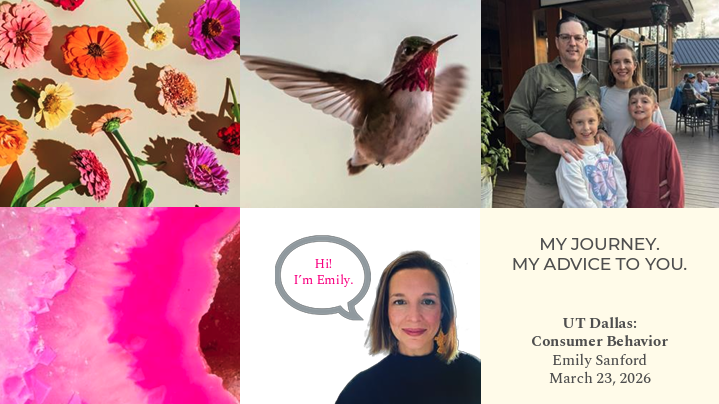
Authenticity is the ice breaker
There's a reason speakers tell jokes at the beginning of a presentation. It's not really about the laugh. It's about lowering the walls. When a room relaxes, it opens. And when people feel like they're with a real human and not a polished performance, something shifts.
You can do that with a joke. But you can also do it by just... being real.
When I introduced myself that day as a mom, as a geologist's daughter, as someone who unabashedly loves pink — the room changed. Not because any of those things are particularly impressive. But because I went first. I said: here's who I am, beyond my credentials. And that made it safe for them to show up that way too.
That's what a personal brand actually is. Not a logo. Not a LinkedIn aesthetic. Not a personal marketing campaign. It's the answer to the question: when you walk into a room, do people feel like they're meeting a person — or a resume?
Nemawashi: the pre-work nobody talks about
When I was at Team One working on the Lexus account, I learned a concept that changed how I think about influence and relationships in business. It came from Toyota and Lexus's Japanese cultural roots, and it's called nemawashi (根回し).
Literally, it refers to the practice of tending to the roots of a tree before you transplant it — preparing the soil, making sure the foundation is ready. In business, it means doing the relational groundwork before the big meeting. Before the pitch. Before the ask.
I’d been practicing this throughout my career without a name for it. As one small example, at The Richards Group, before we stood up to deliver a high-stakes new business presentation — polished, rehearsed, credentials at the ready — the most important thing we could do was spend the first few minutes, as the prospective clients gathered, genuinely connecting with the people on the other side of the table. Not schmoozing. Not performing. Just noticing. Complimenting something real. Finding a thread — kids, a necklace, a shared interest — and pulling on it just slightly.
My dad was a geologist. You'd be surprised how many times that comes up when someone's wearing an interesting stone.
Those moments aren't distractions from the work. They are the work. They're how trust gets built before trust is needed. And when you're about to ask someone to believe in your idea, your agency, your pitch — trust is everything.
Whole humans at work
At Sunny, we believe that when people get to know each other as whole humans — not just colleagues — teams work better. Engagement climbs. People stay.
One of the things we do internally at Sunny is use user guides — a small, surprisingly powerful practice where team members share a little about themselves beyond the job description. Your strengths and values. What brings you energy and what drains it. Your best working hours and the context that makes you tick. Mine covers things like: I'm at my sharpest early in the day, I'm truly off from 5–7 (mom hat firmly on!), and yes — I have been known to check off my to-do list in a carpool line.
It sounds almost too small. But what happens when people read each other's user guides is remarkable. I learned that our CGO, Jen Lipsey, has a deep love for animals and — plot twist — lives on a farm. (Occasionally confirmed by a chicken or goat making a cameo on Zoom. 🐓) I learned that Bala, our head of engineering, shares my maybe-borderline-obsessive love of organization and finding calm through controlling the chaos. Suddenly, you're not just working with the CGO or the engineering lead. You're working with people — with whole lives, quirks, and passions that have nothing to do with their job titles and everything to do with what makes them them.
The work doesn't change.
But the relationship to the work does.
This is exactly what we've built into Sunny Workplace™ — a team-building and employee-engagement platform that turns the insight behind user guides into something teams can actually use every week. When people feel seen as full humans, they bring more. They stay longer. They care more. And the team performs better for it.
The algorithm knows this
Here's something worth paying attention to: LinkedIn's algorithm is actively favoring individual voices over brand posts. Influencers are commanding enormous audiences and enormous reach because people connect to humans, not companies. Not mission statements. Not product shots.
This isn't an accident. It's not a trend. It's a reflection of something true about how people actually work: we follow people we trust, and we trust people we feel like we know.
Your personal brand — whether you're a twenty-two-year-old just starting out or a senior leader with decades of experience — is not about self-promotion. It's about making yourself knowable. Relatable. Real.
When you show up consistently as yourself — your values, your voice, your genuine perspective — you build something that no ad budget can buy: earned trust.
And earned trust? That's what moves people. That's what gets things done.
It starts with one small step
So here's what I'd leave you with.
You don't need a personal branding strategy. You don't need a content calendar or a signature aesthetic or a polished tagline (though none of those things hurt).
What you need is the willingness to take the first step.
To show the slide with the picture of your family before you show the slide with your credentials. To ask the question in the meeting that acknowledges you're a human in the room, not just a role. To write the LinkedIn post that shares what you actually learned, not just what looks impressive.
Connection is the strategy. Authenticity is the advantage. And your personal brand? It's just you — showing up as all of it.
That's more than enough. That's everything.
Emily Sanford is CMO at Sunny, a nonprofit dedicated to building a more connected world. She also writes at A Glittering, where she explores the intersection of career, creativity, and what it actually means to lead with heart.