
The one thing AI can't build for you: YOU.
I walked into a Consumer Behavior class at UT Dallas yesterday ready to share my story. Twenty-plus years of career is easy to talk about when you've lived it. What I didn't know was how it would land.
I mean, I had a deck. A really beautiful one, actually. Intentionally visual, very few words — each slide anchored in my actual career story. But the first slide was something different. It was a grid of images that had nothing to do with marketing: a hummingbird. Pink agate (my dad was a geologist — he'd probably be offended by the hot pink version, but here we are). Flowers. My family. Things I love and don't hide. That slide was a deliberate choice — a way of saying a whole human being just walked in, not just a resume. Because showing up authentically — at work, in a classroom, in a boardroom — is something I've come to believe in completely.
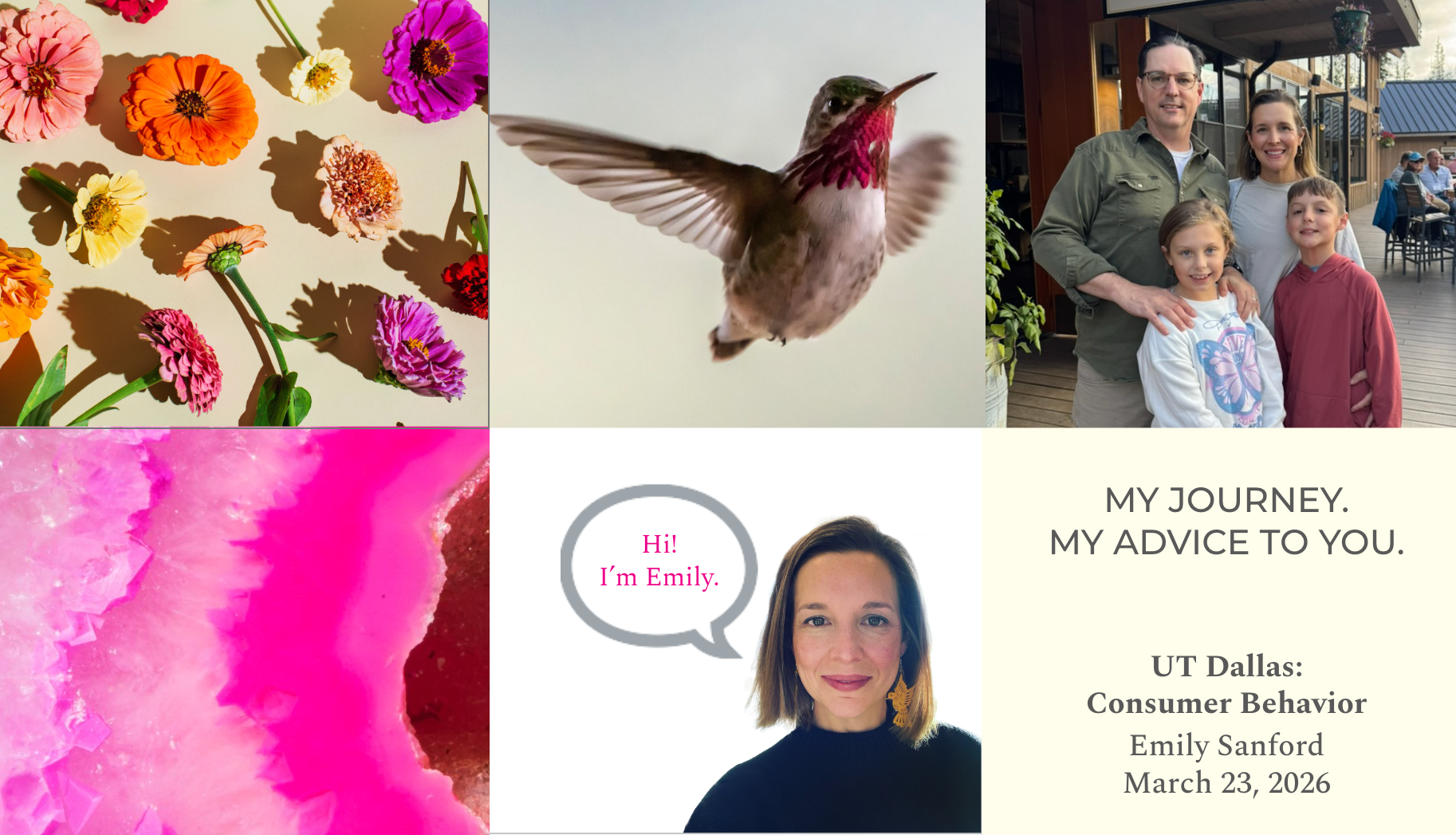
I'll also admit: I gave Claude one shot at building this deck. As an experiment — because yes, I use AI constantly and I'm genuinely excited about what it can do. It tried hard. It even threw some pink in there. But I had a vision in my head that required my artifacts — screenshots from past roles, personal photos, images that mean something to me. The kind of thing that lives in your history, not a prompt. So I built it myself, which honestly made it better. The point isn't that AI can't help you — it absolutely can, and will, and should. The point is that no tool can be you. Your story, your voice, your presence in a room. That part is still yours.
More on that in a second.
I had stories. I had 20-plus years of marketing career to pull from. But I've been in enough rooms to know that what's on the slides and what actually lands are two very different things.
What landed?
Thankfully, a lot! But one thing surprised me.
About halfway through, I asked the students: How many of you are worried about AI when you enter the workforce?
A lot of hands.
Then: How many of you are inspired by it?
Crickets. A few cautious half-raises.
And I thought — oh. This is the conversation we need to have.
Here's what I told them, and what I genuinely believe:
Every generation gets its seismic shift. Mine was the internet. Then social media. Then mobile. Each one felt terrifying and like it was going to make everything we knew obsolete.
And every single time, the people who figured out how to use it — not fear it — won.
I was a 26-year-old raising my hand in a meeting saying we can do email marketing when nobody else knew what that meant. Not because I had special skills. Because I was curious, and hungry, and willing to figure it out. That curiosity accidentally became the whole trajectory of my career — data-driven marketing, digital transformation, building something from nothing three times over.
That's exactly where these students sit right now with AI.
They are more equipped to learn it, apply it, and build careers with it than most people already in the workforce. That's not a threat. That's a massive, freaking opportunity.
But — and this is the part I really wanted them to hear —
The thing AI cannot replicate is you.
Not your resume. Not your output. You. The way you make someone feel seen in a meeting. The way you walk into a room and light it up. The way you crack the code on a prickly colleague by just... getting to know them as a person.
That is the differentiator. Now more than ever.
I'm CMO at Sunny, a nonprofit focused on meaningful connection in a modern world. This isn’t just our tagline, it's what the data keeps telling us. In 2025, The World Economic Forum named “human skills — trust, adaptability, connection — as the most valuable and most underinvested capabilities in the modern economy.” Sunny is building technology to bring that back into the flow of work and life because we genuinely believe the world needs it.
Connection wove through everything I said today. Not as a strategy. Just as the truth of how I've built my career and my life.
The five things I left them with — which, honestly, are the five things I'd tell my younger self:
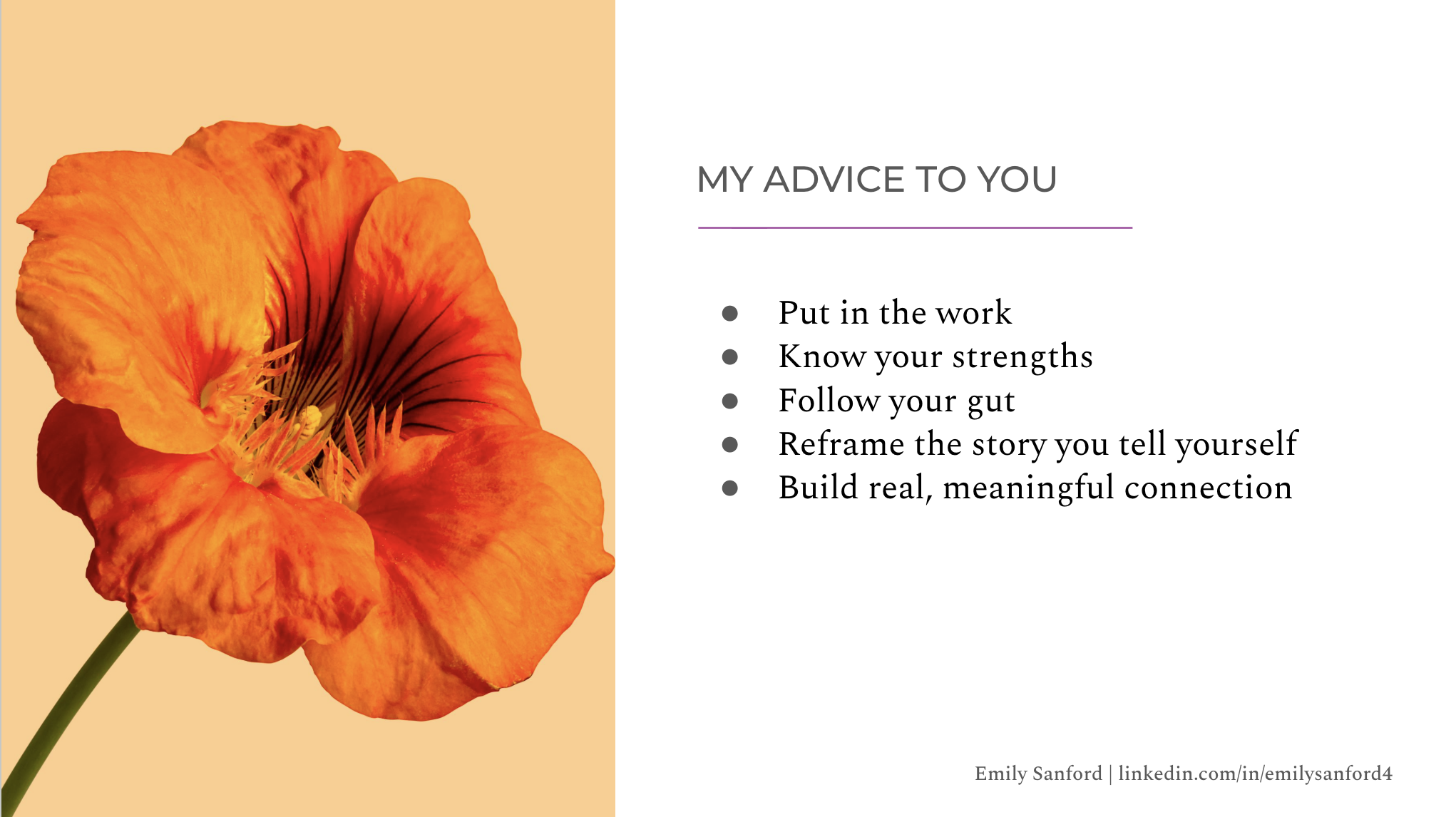
1. Put in the work. Raise your hand before you feel ready. Say yes to things you haven't done yet. The email thing. The new business pitch on a private jet. The scary conference call. All of it was built by showing up and doing the thing.
2. Know your strengths. Take the tests — Clifton Strengths, Myers-Briggs, whatever resonates. I didn't know my real strengths until way later than I should have. Turns out I'd been living them all along; I just hadn't named them. Positivity. WOO (Winning Others Over). Belief. No wonder I love a room full of people who want to go somewhere!
3. Follow your gut. Your body knows before your brain does. If something feels off in an interview, that's data. If something lights you up, that's data too. I've made my best decisions — and my worst ones — based on whether I listened.
4. Reframe the story you tell yourself. I came in a glorious second for a job I wanted. And that second place is what led me to Team One, to Julie Michael, to the next chapter. The story you tell yourself about what happens to you shapes everything that comes after.
5. Build real, meaningful connection. Not a network. Relationships. There's a difference. The people who have opened doors for me weren't LinkedIn connections — they were people I'd actually talked to, showed up for, let see me. That's what lasts.
After the talk, a few students came up — which I always think is the boldest move, by the way. One of them told me she's moving to New York City after graduation. Not because she had it all figured out. Just because it feels right. She had interviews lined up, a fire in her eyes, and zero apologies for going for it.
I told her: that's exactly right. Follow that.
She reached out on LinkedIn. A few others did too.
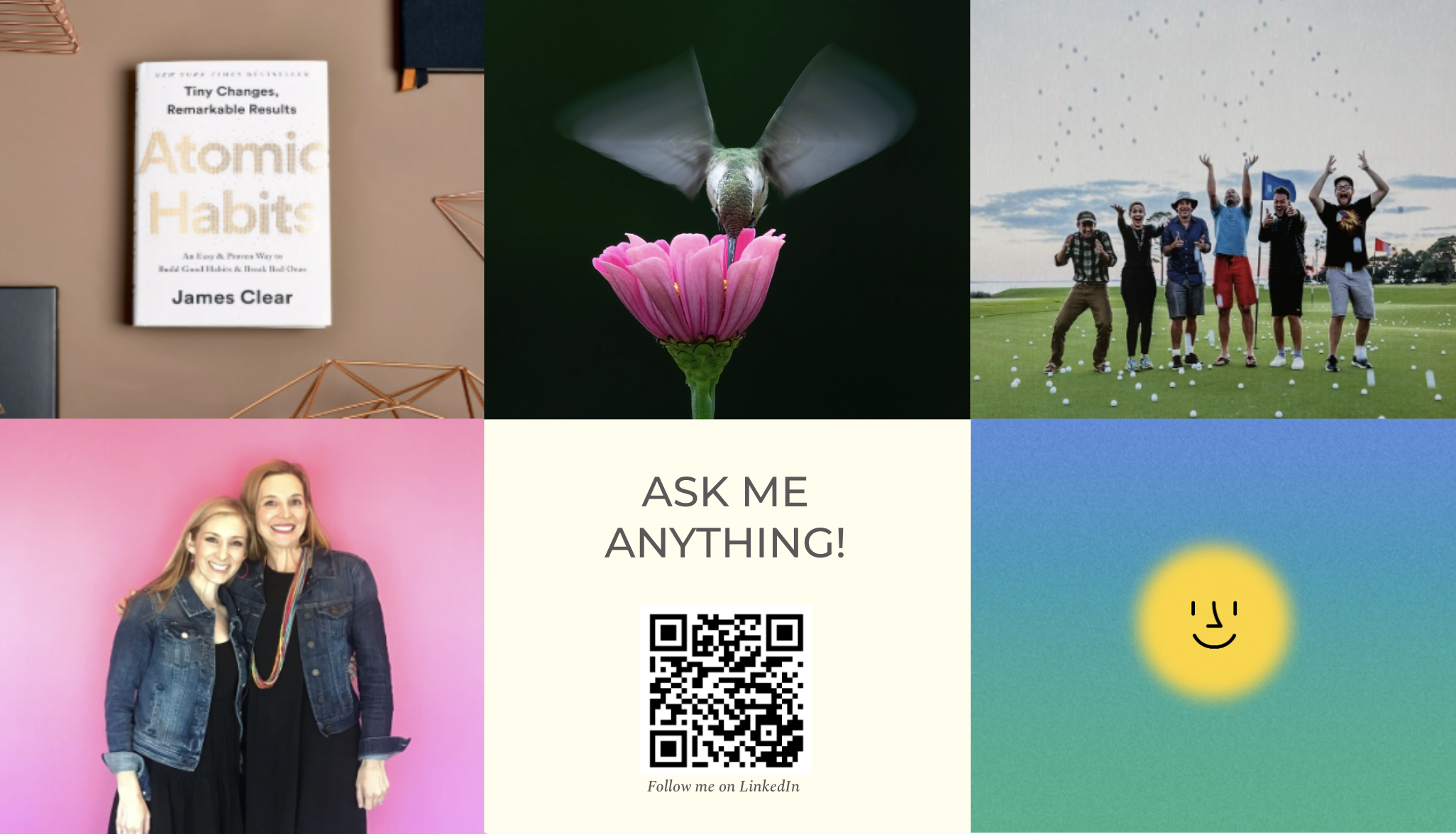
And I meant every word of what I said to all of them: stalk my LinkedIn. If you see a connection you need, ask me. I'll open the door. You walk through it and do the rest — but I'll open the door.
The students who will thrive aren't the ones who know the most. They're the ones who stay curious, build real relationships, raise their hand before they feel ready, and show up as a full human being — not just a set of skills.
The AI age isn't coming for them.
It's waiting for them.
LFG! 🚀
Are you a student, a new grad, or someone figuring out your next chapter? I'd love to connect. Find me on LinkedIn — and yes, I actually respond.
#AGlittering #Connection #Leadership #MarketingCareer #Sunny