
It finally let me use mine.
Dr. Iain Smith — our head of behavioral science at Sunny and one of the most brilliant humans I know — posted something on LinkedIn recently that stopped my scroll.
He was talking about AI slop. The avalanche of AI-generated content flooding our feeds, our inboxes, our meeting notes. The sameness of it. The hollowness. The way it's starting to feel like everyone is saying everything and no one is saying anything.
Create, he said. Be human. The world needs your voice, not a machine's.
YES. AND.
I agree with everything Iain said. One hundred percent. Especially in the workplace, I feel it too — the slop is real and it's everywhere and it's exhausting. But I also want to offer another point of view. Because for me, AI has been the thing that finally got my voice out into the world.
And I think two things can be true.
Let me back up.
I have never called myself a writer. But I have always been a storyteller.
My brain is constantly flooded with ideas. I find myself telling the same story to different friends — at dinner, on a walk, via a very long voice memo — and feeling genuinely lit up by it every time. I have things I want to say. Perspectives I want to share. Moments I want to capture before they slip away.
And for most of my life, those stories just... circulated. They lived in my head and in my conversations and nowhere else.
Because sitting down to write? For hours? Obsessing over whether it was good enough, polished enough, right enough? That would drain the creativity right out of me. I'm wired for momentum. For connection. For talking it through out loud. The blank page and I (aside from my personal journal) have never been friends.
So the stories stayed in my head. Until AI.
Here's what I actually do — and I want to be really specific about this, because I think the nuance matters.
I don't ask AI for ideas. I don't ask it what to post or what my angle should be or how to sound interesting. That wouldn't be me. That would be slop.
What I do is this: when I'm filled up with something — a moment, a story, a feeling I can't shake — I turn on the audio feature and I just talk. Sushi fresh, as we say at Sunny. The freshest off the boat. I tell AI what just happened the same way I'd tell my best friend on the phone — raw, real, unfiltered, sometimes rambling, yes.
Don’t come at me with, “just call that friend.” I love my friends. I have a tribe. Life-long besties and college besties. Trust me, my girlfriend, Dottie, and I talk for hours straight on our long Sunday walks. And I am dropping voice memos to my girls all. the. time. AND sometimes I just need to talk and have the bot listen. Listen to all my fresh thoughts, dot connecting, and weaving together stories I want to get just right.
I ask AI to help me shape it. To find the structure in the mess. To make it digestible without making it generic.
And then I scrutinize every single word. Sometimes just that takes me hours. I change what doesn't sound like me. I cut what feels dry or flat or corporate. I add back the parts that make it mine. The em dashes. The run-on sentences that are actually just how I talk. The capitalizations. The asides.
At the end of the day, these are still my stories. My perspective. My voice. AI didn't write them — it helped me get them out of my head and onto the page before the energy behind them faded.
I'm not claiming to be an author. The stories are mine. Every word I'd stand behind.
Even right now — I'm in my car. I read Iain's post maybe ten minutes ago. I'm commuting to a work session, dictating into my phone, getting these thoughts out while they're alive and urgent and true. (Sure, I took a few days to review, polish, edit, AND decide if i was brave enough to post it.)
That's the unlock. Not AI writing for me. AI making it possible for me to write now — in the car, in the carpool line, in the five minutes between one thing and the next — instead of waiting for a quiet Saturday afternoon that may never come.
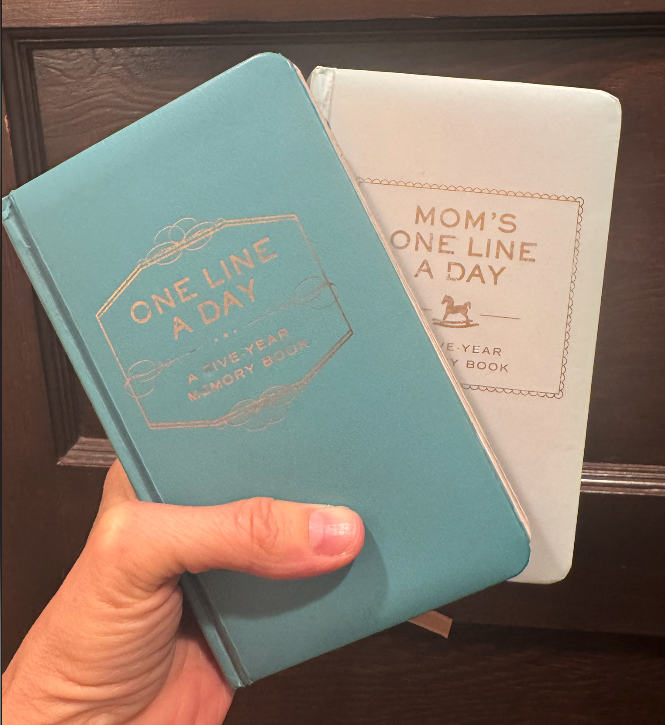
Here's something most people don't know about me. I’ve been journaling for decades. Filling blank pages with my thoughts, my fears, my ideas, my ambition, my heart.
And, most sacred to me, for seven years, I wrote in a one-line-a-day journal. One for Owen. One for Vivian. Every single day — just a line or two about something small and true and worth remembering from that day. I filled a five-year book for Owen, then kept going into a second. I filled one for Vivian. Hundreds and hundreds of tiny entries, captured in real time, before the moment slipped away.
Nobody was ever going to read those books but my family. There is no audience beyond them. No algorithm. No angle. Just a mom who wanted to remember.
A Glittering is all of that, but louder.
When I started my blog, I started to overthink it the way only a marketer can. What's my niche? Who's my target audience? What's my content strategy? And then I crumpled up the paper. I'm not trying to be a marketer here. I'm trying to be myself.
A Glittering can be anything. The name is intentional: a glittering is a flock of hummingbirds — all that cross-pollination, all that inspired movement — but it's also just glitter on the floor. A beautiful, joyful scatter of things. It can be about packing. About volunteering with my kids. About what I've learned in twenty years of marketing. About grief and gratitude and the crystal balls I refuse to drop.
It's mine. And that's the whole point.
I joined Substack because I wanted an easy way to deliver blog posts to people who wanted them — my mom, my aunt, the college friend I've lost touch with who told me once that my stories made her feel less alone. I manually copy every post over from my website because I own my stories. If Substack disappears tomorrow, my words are still mine.
I don't chase subscribers. It’s free. Read if you want. Or don’t.
I write when I feel called to write — sometimes weekly, sometimes not for months. Because the moment I treat this like a content calendar, I lose the thing that makes it worth anything: the energy behind it.
Elizabeth Gilbert writes in Big Magic that ideas have consciousness. That they move through the world looking for someone willing to bring them to life. I believe that wholeheartedly. When an idea comes to me with urgency — get this out, get this out now — I've learned to listen. Because if I wait for the right day or the right algorithm window or the right level of polish, the energy drains out of it. And those ideas never make it into the world.
I want to say one more thing, and it's the part I've been a little hesitant to say out loud.
I see the shaming posts. The ones about AI being bad for the planet (I know, and I hate it, and I do try to be responsible about when and how I use AI. AND I believe the people with the power and money to solve that problem should be solving it). The ones that make you feel like using AI means you're lazy or inauthentic or cutting corners. And I'll be honest — I've felt that shame. I've wondered if people would stop reading my stuff if they knew.
And then I thought: that's bullshit.
If I'm going to show up authentically — and that is the whole point of everything I'm doing here — then I have to be authentic about this too. AI has enriched my life. It has made me more creative, not less. It has gotten my stories out of my head and into the world in a way that nothing else ever has.
My dad was always an early adopter. He was first in line in Corpus Christi, Texas for the original iPhone. He started a YouTube channel, CCGeology, in 2009 (seventeen years ago, people!) I think I got that from him.
We can't stop this train. It's here. The question isn't whether to get on — it's how to ride it in a way that feels true to you. For me, that means using it as an accelerant for my own voice, not a substitute for it.
So yes, Dr. Iain Smith. Create. Be human. The world needs your voice.
AND — if AI is what finally helps you use it? Get on board.
Emily Sanford is CMO at Sunny, a nonprofit dedicated to building a more connected world. She also writes at A Glittering, where she explores the intersection of career, creativity, and what it actually means to lead with heart. Follow along on Substack.